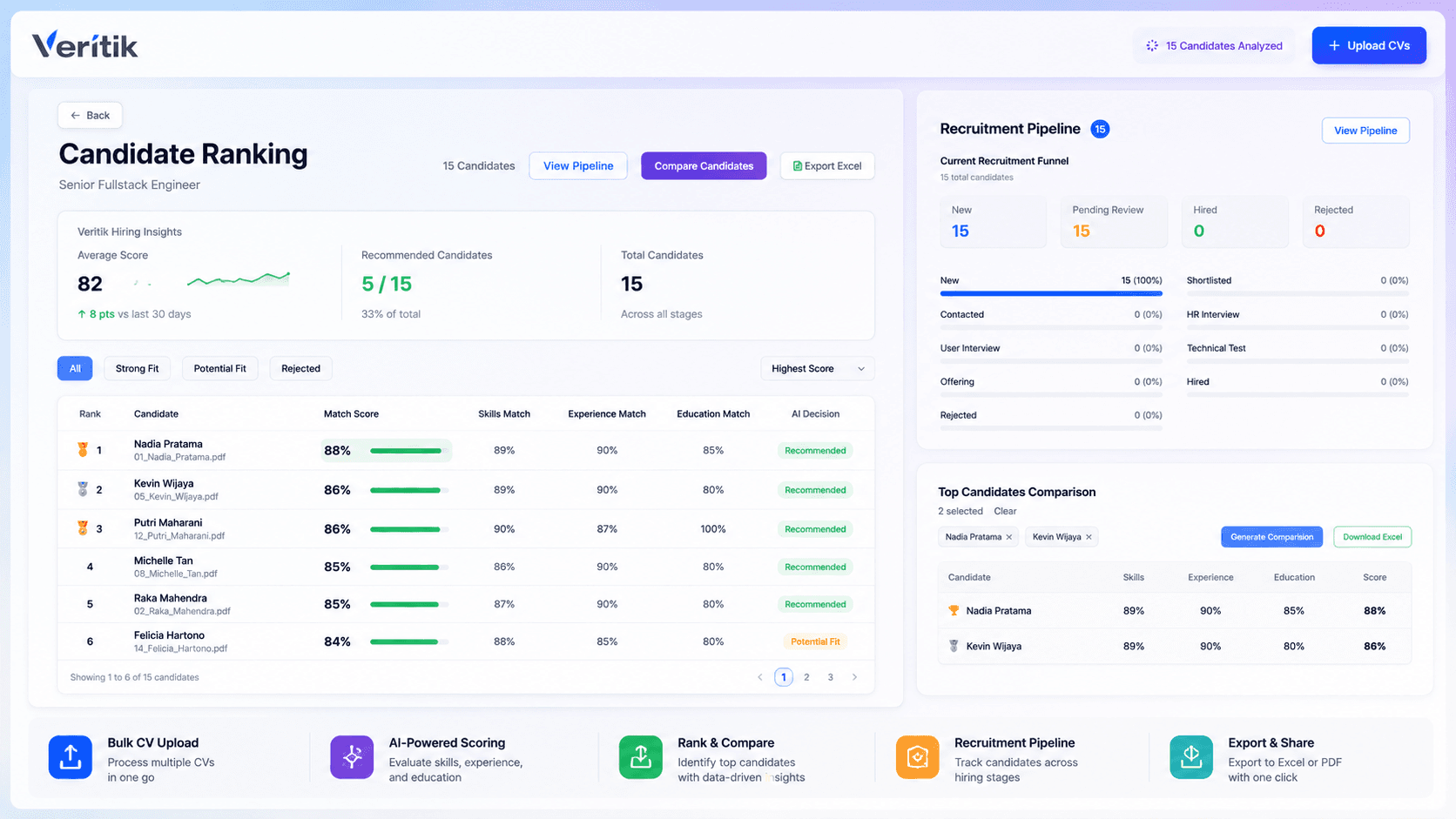
01 / Overview
One product surface for a connected review process.
Veritik is a personal product actively designed and developed around recruitment and candidate screening. It connects job setup, candidate information, resume processing, analysis, ranking, comparison, and structured evaluation in a coherent workflow.
02 / The problem
Candidate information is only useful when it can be reviewed in context.
Recruitment teams often need to evaluate many candidate profiles against the same job requirements. The difficulty is not merely storing applications; it is turning unstructured resume information into something that can be reviewed consistently and compared meaningfully.
Veritik explores how a connected product workflow and AI-assisted analysis can support that work without removing human interpretation from the process.
03 / Product workflow
Designed around the sequence of evaluation.
Create a job
Define the role and the requirements candidates will be reviewed against.
Add candidates
Bring candidate profiles and resume information into the recruitment workflow.
Analyze
Use structured and AI-assisted processing to make candidate information easier to review.
Rank
Surface candidates in relation to the selected job context.
Compare
Review relevant candidate information side by side.
Decide
Use the organized evidence to support—not replace—human judgment.
04 / Product views
The workflow, shown through the product.
These are real product views using demonstration candidate data. Each visual represents a distinct part of the screening and evaluation flow.
01 / Evaluation overview
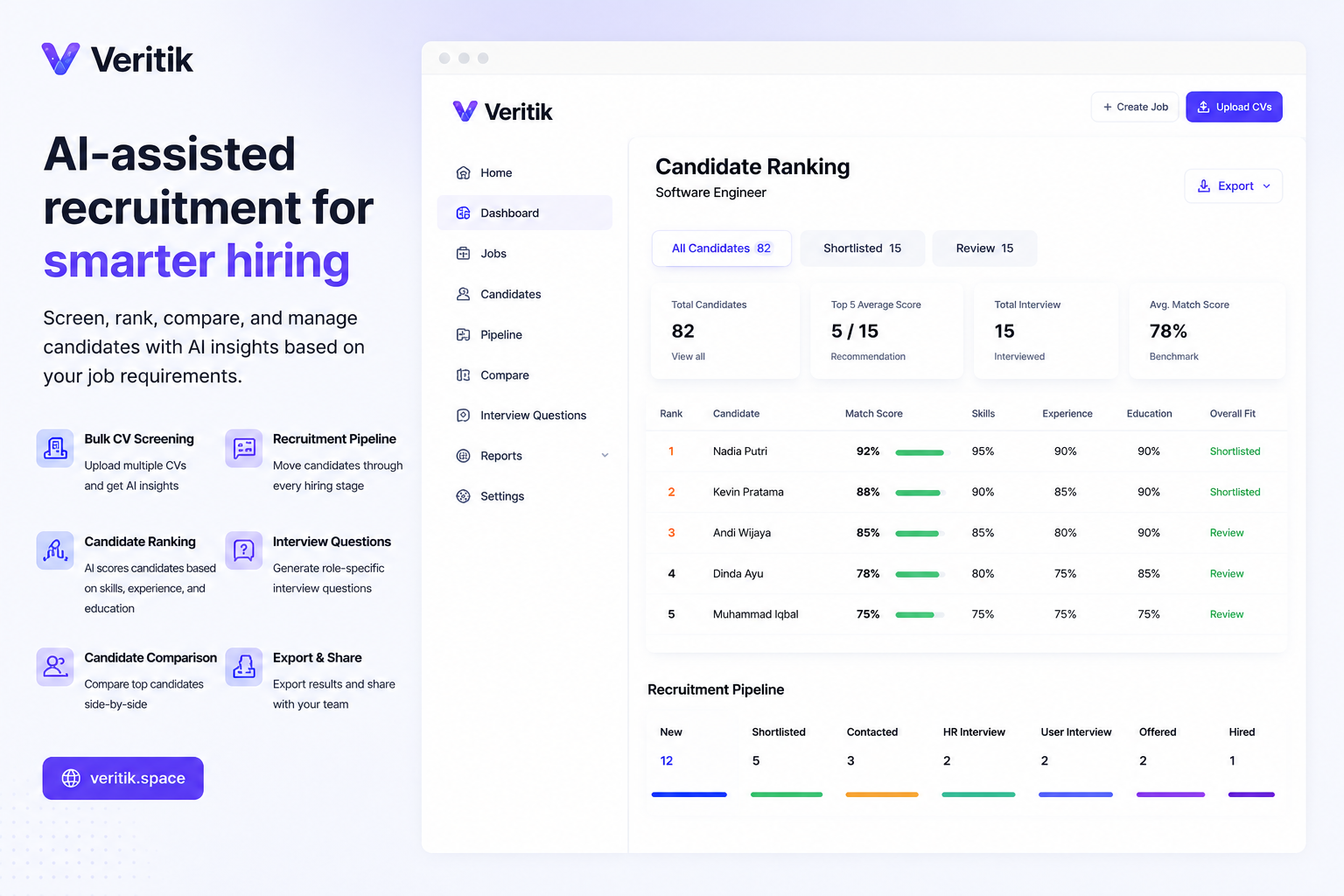
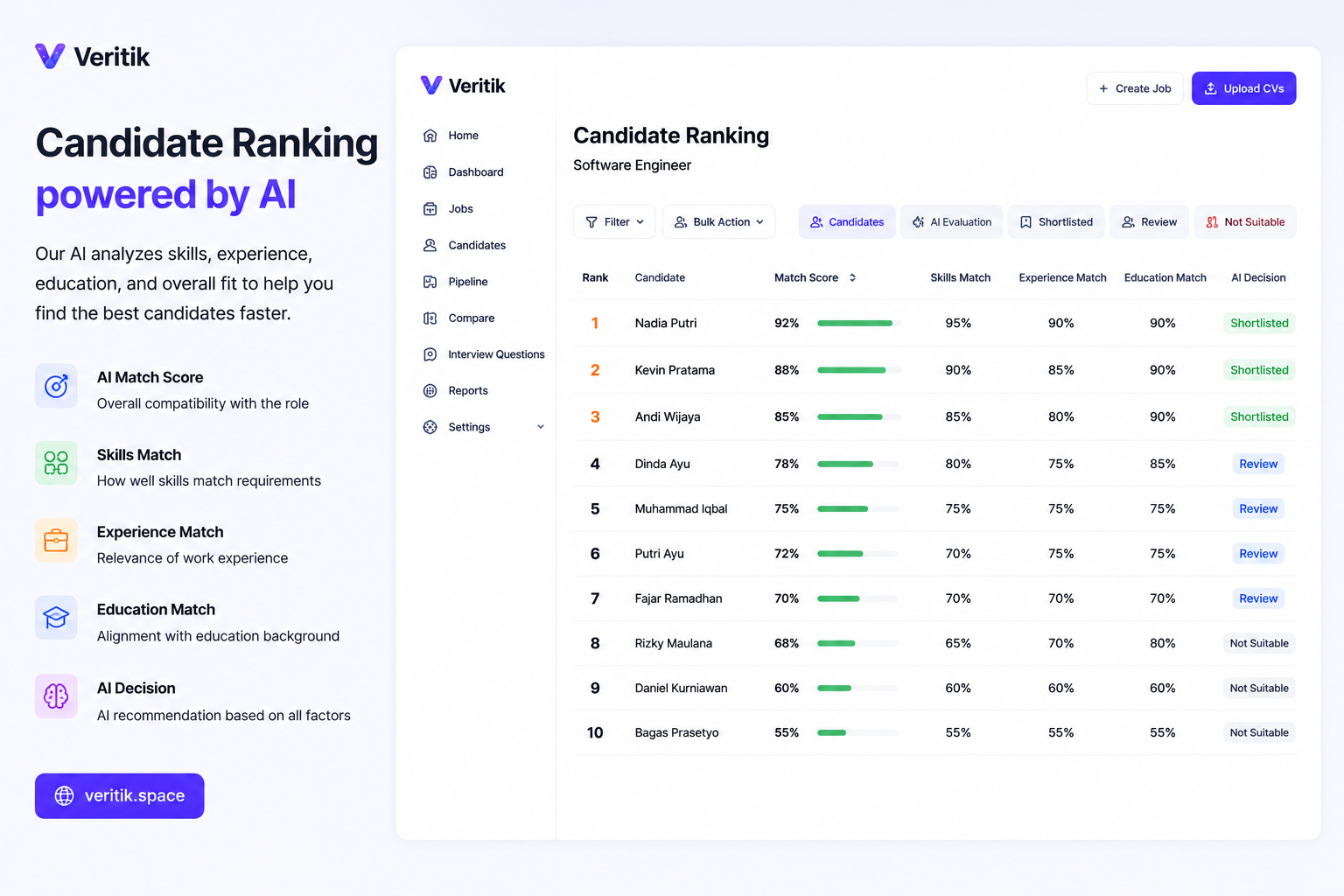
Candidate ranking
Candidates are presented in the context of a selected role, making the review sequence and relative signals easier to scan.
02 / Workflow visibility
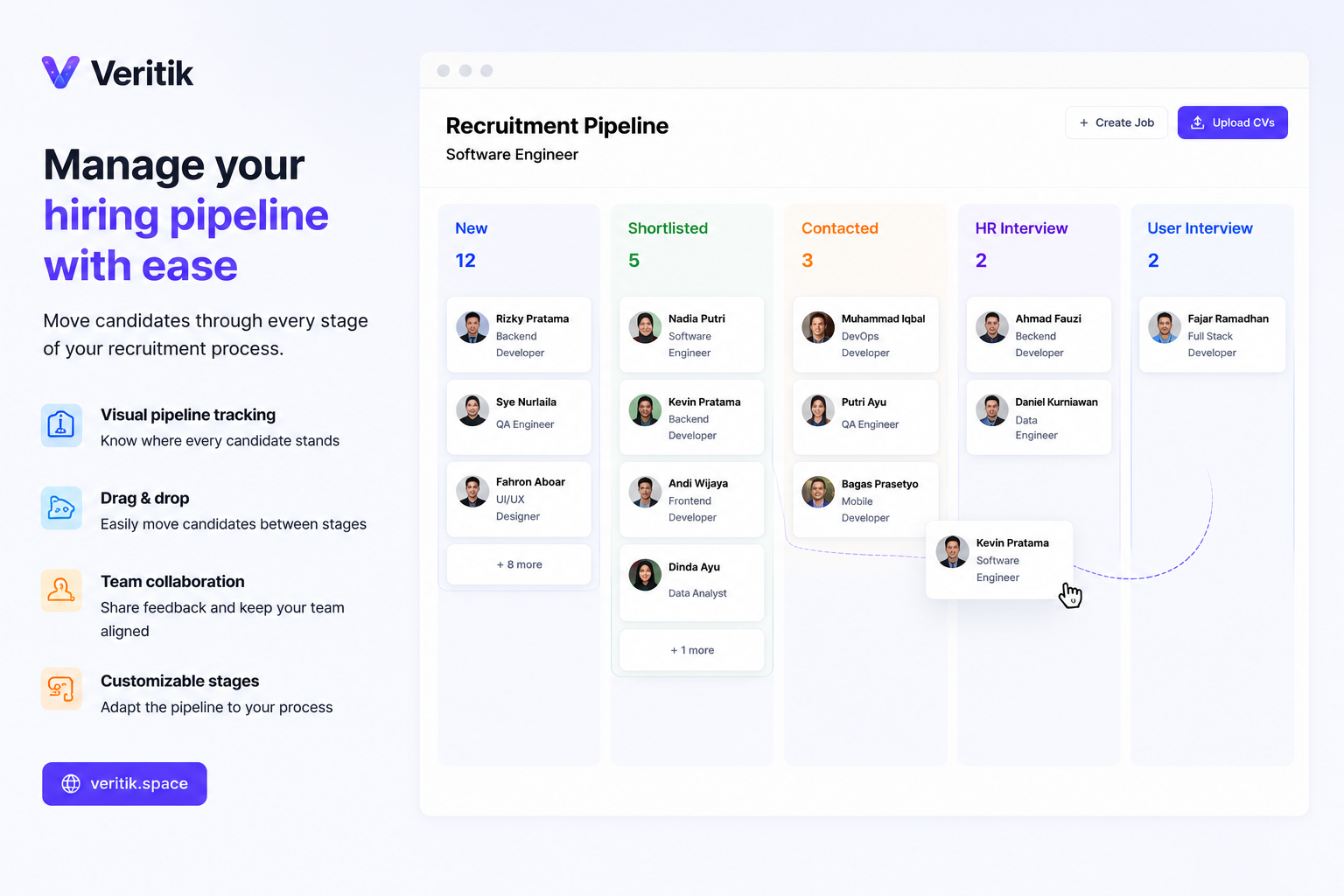
Recruitment pipeline
The pipeline view brings recruitment progress into one product surface so candidate movement can be followed across stages.
03 / Side-by-side review
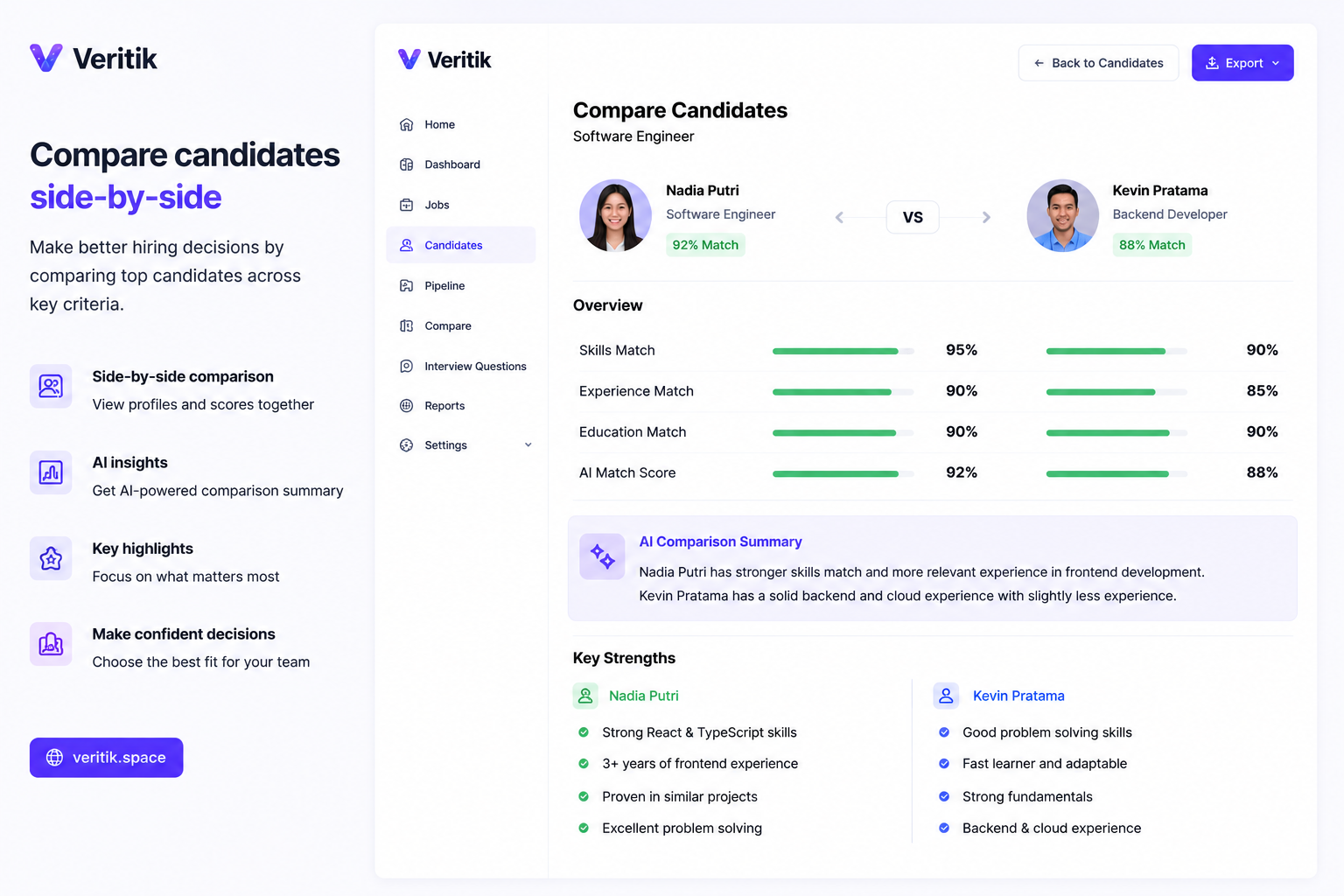
Candidate comparison
Comparison places candidate information next to the same job context, supporting a more deliberate review without treating the product as the decision-maker.
04 / Decision support
AI-assisted screening
AI-assisted analysis is presented as an input to evaluation. Recruiters remain responsible for interpretation and the final hiring decision.
05 / Engineering the product
A technical foundation chosen around the workflow.
The product connects tenant-scoped recruitment data, authentication, document extraction, validated AI output, and export within one application workflow. The foundation below reflects the current PRD without implying undocumented infrastructure.
- Data & authentication
- Supabase PostgreSQL · Supabase Auth · Google OAuth
- AI
- OpenAI · Structured Outputs / JSON Schema where supported · Runtime validation
- Document processing
- PDF.js / pdfjs-dist · Mammoth for DOCX extraction
- Runtime
- Vercel
- Export
- ExcelJS · PDF generation tooling
06 / Engineering decisions
Boundaries that protect the product workflow.
Human state is separate from AI recommendation
- Context
- An AI assessment and a recruiter’s operational decision answer different questions.
- Approach
- Veritik keeps AI Recommendation separate from Recruitment Status. AI evaluation does not move candidates through the pipeline, and status changes do not alter scores or recommendations.
- Why it matters
- The boundary keeps human accountability explicit and prevents automation from silently becoming a hiring decision.
Treat AI output as untrusted input
- Context
- Model responses can be malformed, incomplete, or inconsistent with the product’s score contract.
- Approach
- Assessment uses structured output where supported, followed by runtime validation. Required scores must be numeric values from 0–100; invalid responses are rejected before persistence.
- Why it matters
- Ranking and comparison depend on trustworthy domain data, including legitimate edge values such as 0 and 100.
Fail explicitly during document processing
- Context
- A file can appear valid while containing no readable resume text, or one file can fail inside a larger batch.
- Approach
- Veritik validates format and extracted content, reports each file independently, and does not send image-only PDFs without a text layer into scoring.
- Why it matters
- Recruiters can distinguish a failed extraction from a low assessment, while successful files in the same batch remain usable.
Enforce workspace-level data isolation
- Context
- Jobs, candidate profiles, notes, and evaluations contain sensitive recruitment data.
- Approach
- Jobs and candidates belong to a workspace. Protected operations validate the session, workspace membership, and resource ownership on the server.
- Why it matters
- Authorization follows the data boundary and prevents one workspace from reading or changing another workspace’s resources.
07 / Reliability by design
Failures stay visible and actionable.
Independent file processing
One failed CV does not hide successful results from other files in the batch.
Typed document failures
Invalid, encrypted, unreadable, timed-out, and OCR-required PDFs remain distinguishable.
Validated AI output
Malformed assessment data is rejected before it can become a valid persisted result.
Privacy-conscious observability
Production telemetry must exclude CV contents and candidate personal data.
08 / Responsible AI
AI as decision support, not decision authority.
Evaluation is job-specific and evidence-led. AI Recommendation remains separate from Recruitment Status, and recruiters remain responsible for reviewing the underlying candidate information and making every hiring decision.
- Human in the loop
- Evidence over automation
- Job-specific evaluation
- Separate recommendation and operational status